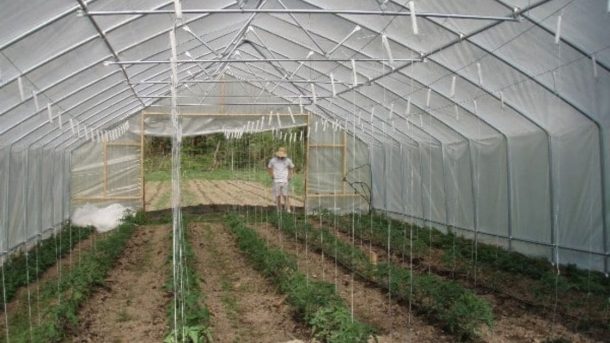
A shade house should be located in such a way that it is well connected with market for input supplies and sale of its produces. This structure should be constructed away from buildings and trees, so also away from industrial or vehicular pollutants. The site should be free from drainage problem. There should be provision of electricity and good quality water. However, wind breakers may be located 30m away from the structure.
ScientificFarmingWeb
What are the benefits of Shade house?

The benefits of shade house are it helps in cultivation of flower plants, foliage plants, medicinal plants, vegetables and spices, used for fruit and vegetable nurseries as well as for raising of forest species etc, helps in quality drying of various agro products, used to protect against pest attack and from natural weather disturbances such as wind, rain, hail and frost. It is used in production of graft saplings and reducing its mortality during hot summer days. Used for hardening tissue culture plantlets.
What are the benefits of brown manuring?

Brown manuring is an eco-friendly weed management practice which suppresses the weed population and growth during the early stage of crop growth. Legume manuring crops supplies nitrogen to component crop plants through biological nitrogen fixation and thus, a significant part of nitrogenous fertilizer can be replaced. It increases organic carbon content of soil and improves the physicochemical and biological properties of the soil. Brown manuring’s can conserve soil moisture and reduce runoff and wind erosion. Enhanced soil fertility, lesser weed competition as well as other benefits accrued under brown manuring, leads to higher crop productivity and economic gain to farmers.
What are the points to be considered for choosing brown manure crops?

Choice of the brown manure crops is important as severe competition with main crops could cause detrimental effects and result in yield penalty. Ideally, the main crop and brown manure crops should have complementary resource use and niche differentiation in space and time to achieve optimisation in resource use. Crop species that are able to fix atmospheric nitrogen and help to maximize weed control while minimizing input cost and risk are the best suited ones. Other preferred criteria are affordability and easy availability of seeds, rapid crop growth and high dry matter production in less span of time, high competitiveness with target weeds, high ground cover to conserve moisture and reduce wind erosion.
Leguminous crops which fix nitrogen into the soils along with addition of organic matter are preferably used, such as dhaincha, sun hemp and cowpea; whereas the non-leguminous crops such as niger and wild indigo which provide only organic matter are less used. The combination of cereal and legume is considered ideal because cereals can utilize a portion of the nitrogen biologically fixed by legumes and the combination may provide multiple benefits like enhancement of yield, maintenance of soil fertility and production sustainability along with greater ecosystem services.
What is brown manuring?

Brown manuring is the ‘no-till’ form of green manuring wherein a selective herbicide is applied to desiccate green manure crops before flowering rather than using cultivation (Das et al., 2021). The existing BM technique involves growing green manure crops preferably legumes with the main crop as a co-culture for the initial 25–30 days after sowing and thereafter desiccated by a selective herbicide. It is a ‘no-till’ version of green manuring, where the desiccated green manure crops are left standing in the field along with main crop without incorporation and is allowed to decompose itself in the soil. The desiccated leaves of green manure crops turn brown due to herbicide spray and hence the method is called brown manuring.
How to prepare waste decomposer solution from the started culture?
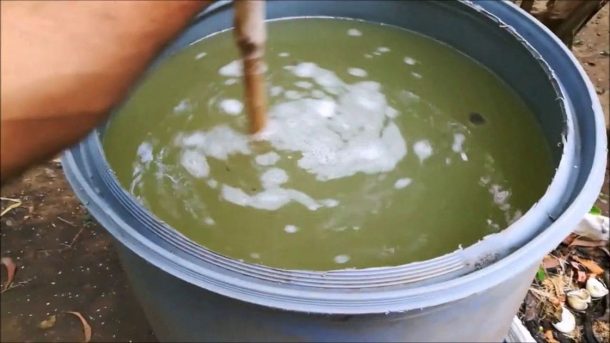
Take 2 kg jaggery and mix it in a plastic drum containing 200 liters water. Now take 1 bottle of waste decomposer and pour all its contents in a plastic drum containing jaggery solution. Avoid direct contact of contents with hands. Mix it properly with a wooden stick for uniform distribution of waste decomposer in a drum. Cover the drum with a paper or cardboard and stir it every day once or twice. After 5 days the solution of drum turns creamy.
What is Coir pith composting technology ?
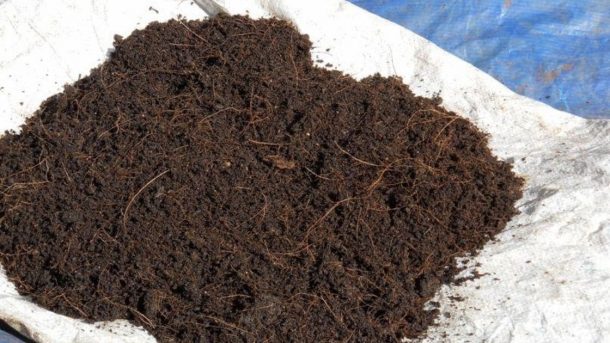
Coir pith is collected from the coir industry without any fiber. If fibrous materials are present, it is removed by sieving at the source itself. Otherwise, it has to be removed at the end of composting at the compost yard. These fibrous materials will not get composted and it will hinder with composting process. It is advisable to bring fibre free coir pith for composting.
What is Coir Pith Compost?

The largest by products of coconut is coconut husk from which coir fibre is extracted. This extraction process generates a large quantity of dusty material called coir dust or coir pith. Large quantity of coir waste of about 7.5 million tonnes is available annually form coir industries in India. In Tamil Nadu state alone 5 lakh tons of coir dust is available.
Coir pith has gained importance owing to its properties for use as a growth medium in Horticulture. Because of wider carbon and nitrogen ratio and lower biodegradability due to high lignin content, it is still not considered as a good carbon source for use in agriculture. It is composted to reduce the wider C:N ratio, reduce the lignin and cellulose content and also to increase the manorial value of pith. Composting of coir pith reduces its bulkiness and converts plant nutrients to the available form.
What is the Coimbatore method of composting ?

Composting is done in pits of different sizes depending on the waste material available. A layer of waste materials is first laid in the pit. It is moistened with a suspension of 5-10 kg cow dung in 2.5 to 5.0 I of water and 0.5 to 1.0 kg fine bone meal sprinkled over it uniformly. Similar layers are laid one over the other till the material rises 0.75 m above the ground level. It is finally plastered with wet mud and left undisturbed for 8 to 10 weeks. Plaster is then removed, material moistened with water, given a turning and made into a rectangular heap under a shade. It is left undisturbed till its use.
In Coimbatore method, there is anaerobic decomposition to start with, following by aerobic fermentation. It is the reverse in Bangalore method. The Bangalore compost is not so thoroughly decomposed as the Indore compost or even as much as the Coimbatore composting, but it is bulkiest.
What is the Bangalore method of composting ?

Dry waste material of 25 cm thick is spread in a pit and a thick suspension of cow dung in water is sprinkled over for moistening. A thin layer of dry waste is laid over the moistened layer. The pit is filled alternately with dry layers of material and cow dung suspension till it rises 0.5 m above ground level. It is left exposed without covering for 15 days. It is given a turning, plastered with wet mud and left undisturbed for about 5 months or till required.