Agricultural schemes

What are the key factors influencing agricultural land prices?

agricultural land

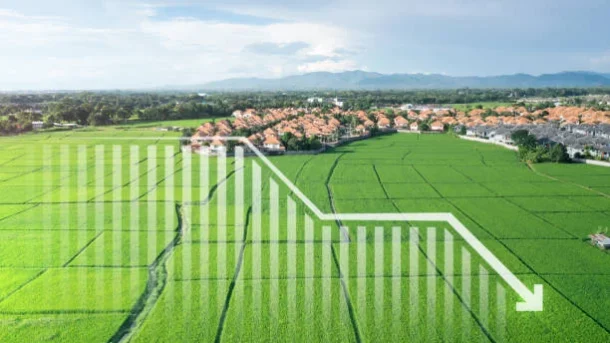
Various variables that depend on the geography, the state of the market, and particular agricultural practices have an impact on the price of agricultural land. A few of the main elements affecting the cost of agricultural land are as follows:

Location: The price of the land is significantly influenced by its location. Agriculture property can be worth more if it is close to urban areas, transit hubs, and other advantages.

Crop Productivity: The land’s productivity, which includes the quality of the soil, the availability of water, and the climate, is a major factor in determining the price of the property. Land that is extremely productive and fertile frequently fetches greater prices.

Demand for Agricultural Products: Farming operations on the land are more profitable when there is a demand for the products they produce. Increased competition for agricultural land might result in higher costs if crop or livestock demand increases.

Economic Situation: Prices for agricultural lands can be influenced by economic variables like interest rates, inflation, and general economic growth. Favorable economic conditions might encourage more investment in agriculture, which would impact land prices.

Government Policies: Government policies, such as taxation, subsidies, and restrictions on land usage, can have an impact on the price of agricultural land.
How are agricultural subsidies and support programs distributed globally?

subsidies

Global distribution of agricultural assistance and subsidy schemes is achieved through a confluence of national and international legislation. Depending on each nation’s agricultural interests, economic situation, and trade agreements, the distribution and types of subsidies vary widely. The following are some typical methods used to disseminate agricultural support and subsidy programs across the globe:

Domestic Subsidies: To boost their agricultural sectors, the majority of nations offer domestic subsidies. These subsidies may be designed to directly aid farmers financially, support a certain agricultural technique, increase production, or stabilize farm incomes. Direct payments, price support mechanisms, input subsidies (such as for fertilizer and seeds), and risk management programs (such as crop insurance) are all examples of domestic subsidie.

Export Subsidies: Some nations provide export subsidie to increase the competitiveness of their agricultural products on world markets. In order to lower the cost of exporting agricultural products, exporters may receive financial aid or incentives.

Market Price Support: To maintain the pricing of agricultural commodities, governments may employ market price support schemes. These schemes entail buying excess produce from farmers at set rates or becoming involved in the market to stabilize prices.

Input Subsidies: To help farmers afford the cost of agricultural inputs including fertilizer, seeds, herbicides, and machinery, several nations offer input subsidie. Input subsidie are intended to increase productivity and increase the economic viability of agricultural production.

Support for Rural Development and Infrastructure: Governments may make investments in rural development in addition to providing direct payments to farmers.

How are subsidies affecting agricultural production and trade?

agricultural production

The conduct of farmers, the competitiveness of agricultural products on the global market, and the overall dynamics of the agricultural sector are all impacted by subsidies, which have a considerable impact on agricultural production and trade. Subsidies can have complex consequences that change according on the type, size, and particular agricultural situation. Subsidies have the following effects on agricultural commerce and production:

Production Incentives: Farmers are frequently given financial assistance through subsidies, which motivates them to produce more. As farmers are driven to boost production to take advantage of the financial aid, these incentives may result in greater agricultural output and higher yields.

Crop Selection: Some subsidies may be intended for a particular crop or class of goods. This may have an impact on farmers’ choices of crops.

Price Support: By establishing a minimum price for some commodities, price support subsidies seek to stabilize the price of agricultural products. This may effect agricultural production and trade dynamics and production choices, leading to surpluses that affect market pricing globally.

Trade Distortion: Agricultural products with subsidies may be more competitive than those from nations without subsidies since they can be purchased on international markets for less money. This may result in trade conflicts and market distortions that have an impact on farmers’ lives in non-subsidizing nations.

Environmental Impact: Some incentives could encourage behaviors that are harmful to the environment, including using excessive amounts of water or fertilizer. Environmental deterioration and resource depletion may result from this.

What are the main obstacles faced in international agricultural trade?

international agricultural

Numerous challenges to international agricultural trade exist that may impede the free movement of agricultural products between nations. Trade regulations, technological specifications, logistical difficulties, and geopolitical factors can all be contributing factors to these barriers. The following are some of the major challenges to global agricultural trade:

Tariffs and Trade Barriers: international agricultural products may have less market access due to import tariffs and non-tariff barriers such import quotas, license requirements, and sanitary and phytosanitary measures (SPS).

Subsidies and Support: Some nations’ agricultural industries receive subsidies, which can affect global market pricing and the competitiveness of farmers in other nations who do not get such subsidies.

Trade Conflicts and Retaliatory Actions: Trade conflicts between nations can result in retaliatory actions, including tariffs or bans on particular agricultural items, which can stymie trade flows.

Technical Standards and rules: For exporters and importers, complying with various technical standards, labeling specifications, and food safety rules can be difficult and expensive.

Intellectual property rights: Trade in agricultural products may be impacted by disputes over intellectual property rights, particularly in the field of agricultural biotechnology.

Infrastructure and logistical problems: Poor transportation and storage systems can cause delays, product deterioration, and higher export and import prices for agricultural goods.

How do government policies impact agricultural market trends?

government policies

Government policies have a significant impact on agricultural market trends and many facets of the agricultural industry. Production, trade, prices, and the general dynamics of the market can all be impacted by these policies, both directly and indirectly. The following are some ways that public policies might affect the agriculture market:

Governments frequently offer financial assistance to farmers in the form of subsidies, grants, or price support programs. These subsidies can lower production costs, promote particular farming methods, and stabilize prices, resulting in an increase in the supply or output of particular agricultural commodities.

Governments utilize trade rules and tariffs to control the flow of agricultural products across international borders. While export tariffs can affect a product’s availability on the global market, import tariffs can shield home producers from overseas rivalry.

Agriculture Price limits: To guarantee that some important goods are affordable for consumers, governments may impose price limits on them. While keeping food costs consistent for consumers, price caps might restrict farmers’ income.

Funding for Research and Development: Investing in agricultural R&D can result in technological improvements, better crop types, and increased productivity. Research that is supported by the government policies can also focus on particular issues facing agriculture, such disease resistance or climate resilience.

What is the current state of the global agricultural market?

global agricultural market

Since I’m an AI language model, I don’t have access to current information, so my understanding is based on knowledge as of September 2021. I am unable to provide information on the current situation of the global agricultural market in 2023 as a result.

I can, however, offer you a general summary of the trends and elements that frequently have an impact on the global agricultural market. A number of variables, such as weather patterns, geopolitical events, trade agreements, and general economic conditions, may cause actual market conditions to shift.

Agriculture supply and demand are in balance, and this has a significant impact on market prices. The level of demand for different agricultural products can be influenced by elements including crop yields, livestock production, and dietary changes.

Climate and weather: Unpredictable weather patterns, such as droughts, floods, and extremely high temperatures, have a substantial impact on crop productivity.

International Trade: The agriculture market is extremely dependent on international trade. Trade agreements, export and import regulations, and taxes all have an effect on how easily agricultural products move between nations.

Government Policies and Subsidies: Government interventions, such as subsidies, price supports, and rules pertaining to land use and agricultural practices, have an impact on agricultural markets.

What is the role of robotics in selective harvesting of high-value crops?

selective harvesting

By offering accurate and effective solutions, robotics plays a vital role in the selective harvesting of high-value crops. Here are several ways that robotics aids in selective harvesting:

Robotic systems are made to move with accuracy and precision, enabling them to choose harvest particular crops or individual fruits without harming the nearby plants or produce. With such accuracy, high-quality harvests are guaranteed, reducing losses and retaining the crop’s worth.

Robotics used in selective harvesting frequently include sophisticated vision systems and sensors. Robots can now discover and recognize mature or ripe crops based on their color, size, texture, or other visual or sensory clues. Robots can precisely focus the harvesting by identifying and identifying crops at the desired level of development.

Gentle handling is necessary to prevent bruising or damage when harvesting high-value crops, such as delicate fruits. Robots can be programmed to carefully handle crops by using suction devices, soft-touch grippers, or gentle gripping mechanisms. This keeps the produce’s quality intact and reduces physical stress on it, making it more acceptable for premium markets.

Speed and efficiency of harvesting are boosted since robots are able to work constantly without the restrictions of human labor. Robots can pick crops at the perfect time, lowering the risk of overripeness and ensuring optimum yield thanks to their capacity to run continuously. Robots can also consistently do repetitive chores, which lowers labor costs and frees up human laborers for more complicated agricultural duties.

Name a government program that aims to promote the cultivation of aromatic crops and essential oil extraction.

government

The “Aroma Mission” is one government initiative that seeks to encourage the growing of aromatic plants and the extraction of essential oils in India. The Government of India has established a program called the Aroma Mission with the goal of boosting the growing of fragrant crops including lavender, rose, lemongrass, vetiver, and other plants abundant in essential oils.

The following are the main objectives of the Aroma Mission:

Growing Aromatic Crops: The objective is to encourage the growth of aromatic crops by offering farmers technical advice, education, and financial help. To assure the production of high-quality aromatic crops, it promotes the adoption of sustainable farming techniques, including as organic farming.

Extraction of Essential Oils: By establishing essential oil extraction units and processing facilities, the Aroma Mission seeks to improve the extraction of essential oils from aromatic crops. This makes it easier to extract aromatic oils from plant matter, ensuring product value addition and improved marketability.

Research and Development: The mission promotes initiatives in the fields of essential oil extraction methods and aromatic crop research and development. This involves research on crop improvement, the creation of high-yielding cultivars, the improvement of extraction techniques, and the investigation of new opportunities and uses for aromatic oils.

Market Linkages and Promotion: The Aroma Mission helps farmers who grow aromatic crops and make essential oils connect with markets. It encourages the use of aromatic oils in a variety of fields, including aromatherapy, cosmetics, perfumery, and pharmaceuticals.

What is the main objective of the National Mission on Sustainable Livelihoods (NMSL)?

Livelihoods

It’s crucial to remember that several government initiatives, missions, and programs are frequently launched and revised to address the demands and difficulties associated with sustainable livelihoods. These programs frequently work to improve people’s quality of life through encouraging entrepreneurship, skill development, income production, and social welfare.

Referring to official government sources, pertinent ministries, or local development organizations would be advised in order to get the most latest information on any specific effort connected to sustainable livelihoods.

Which scheme provides financial assistance for the establishment of marketing infrastructure for organic products?

financial

The “National Program for Organic Production” (NPOP) is one program that offers financial support for the creation of a marketing infrastructure for organic products in India. NPOP is a government program run by the Ministry of Agriculture and Farmers Welfare that aims to support organic farming methods and the growth of the nation’s organic markets.

Financial support is given under the NPOP for a number of organic product marketing infrastructure-related components. The program seeks to aid in the development of effective and reliable marketing channels that guarantee fair prices, enhanced market accessibility, and enhanced market connections for organic farmers and producers.

The specific NPOP elements that support the organic product marketing infrastructure are as follows:

Development of Organic Value Chains: The program encourages the creation of organic value chains, which entail the construction of marketing infrastructure like collection points, processing units, cold storage facilities, grading and packaging facilities, and certification and quality control labs. The establishment and improvement of such facilities are encouraged through the provision of financial aid.

Development of Organic Markets: NPOP focuses on developing organic markets by offering assistance in opening organic stores, farmers’ markets, and retail establishments that are solely devoted to selling organic goods. To raise consumer knowledge and demand, financial aid is also provided for the advertising and branding of organic products.

Market Promotion and Linkages: In order to enhance direct marketing opportunities for organic farmers, the program promotes participation in organic trade shows, exhibitions, and buyer-seller gatherings. 

Certification and Traceability: NPOP offers financial support for organic certification procedures, covering certification fees as well as costs associated with adhering to organic standards. This ensures that organic products live up to the necessary criteria for quality and authenticity, boosting customer trust and commercial adoption.