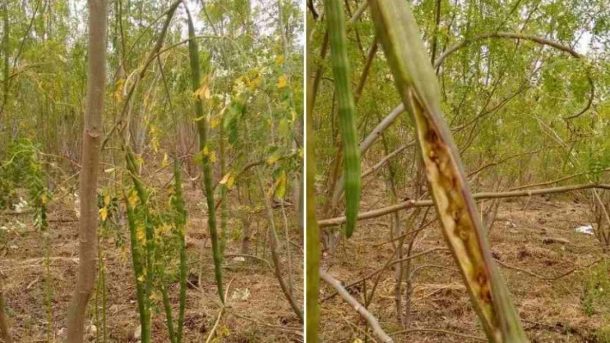
Pods reaching maturity showed extensive rot. The disease symptoms are observed all over the surface of the pods, more conspicuously at the stigmatic end. On green pods, elliptical or elongated sunken spots with reddish brown raised margins can be observed. The pods appear shrunken with thinner dimensions at their stigmatic ends, than healthy ones. In advanced stages of the disease, the pods rot and dried up pre-maturely leaving uneven raised spots over them. Fungicidal spraying is found effective in controlling the disease.
ScientificFarmingWeb
What are the damage symptoms of Fusarium wilt disease in moringa and how it can be managed?
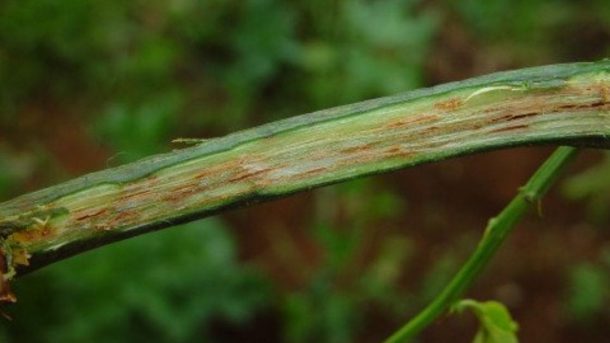
Plants affected with fusarium wilt exhibit yellowing of lower leaves in initial stages and discolouration of younger leaves soon follows. The leaves drop, wilt and dry. The disease affects a few branches in a plant or the entire plant may wilt irreversibly. The affected plants or branches dry up. The vascular bundles become brown. Plants are usually stunted in growth and fruits ripen prematurely.
Seeds should be planted in disease and nematode free soil. The infected plants should be removed and destroyed. Long crop rotation with non-host crops helps in reduction of the inoculum. Incidence of wilt has been significantly reduced with the application of fungicides as soil drench.
Why fruit falling occurs in litchi?
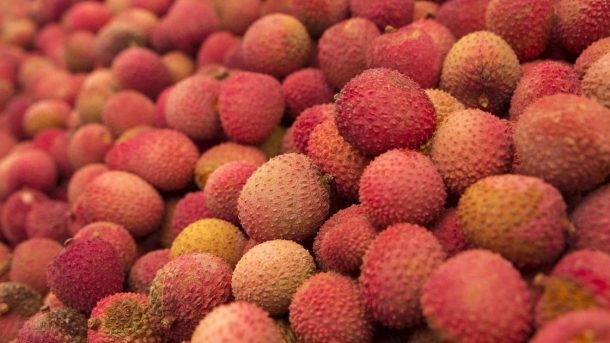
Due to lack of nitrogen and water in the soil and hot and strong winds, litchi fruits start falling at a young age. Due to proper arrangement of manure and water, there is no problem of fruit drop. Planofix (2 ml / 4.6 l) one week after fruiting. One spray of 20 mg/L solution can prevent fruit drop.
How flowering and fruiting occurs in litchi?
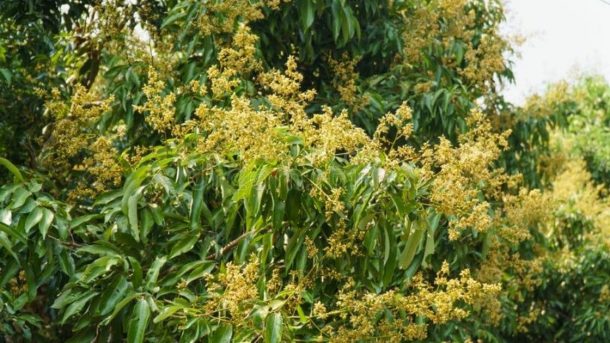
After four to five years, flowers and fruits start coming in the litchi plants prepared by air layering. It has been seen from experiment that by stopping irrigation in plants about three months before the expected time of flowering the scene is very good.
There are three types of flowers in litchi plants. In litchi, the fruit develops only in bisexual female flowers. In these flowers, the stamens are below the ovary so pollination is needed by insects so for more fruiting female flowers should be properly pollinated and insecticides should not be sprayed at the time of pollination, otherwise the fruit is affected.
What can be grown as intercrop in Litchi farming?
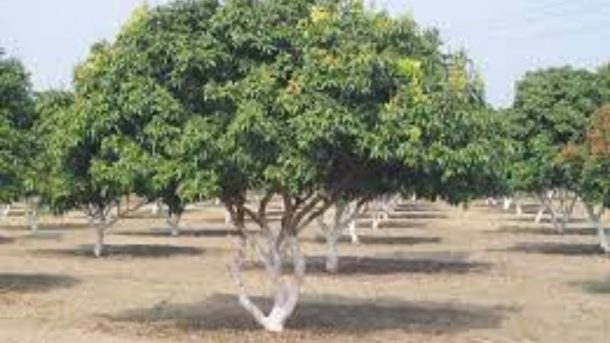
It takes about 15-16 years for the litchi tree to mature completely. Therefore, in the initial stage the land between litchi plants can be utilized properly by planting other fruit plants and pulse crops/vegetables. Due to this, along with additional benefits to the farmers, the soil will improve. Fertility also develops. In the form of intercrops, pulses, oilseeds and other crops like Bodi, French Bean, Okra, Moong, Kulthi, Surguja, Mahua, Paddy etc. can be cultivated successfully.
What is the irrigation requirement for litchi farming?
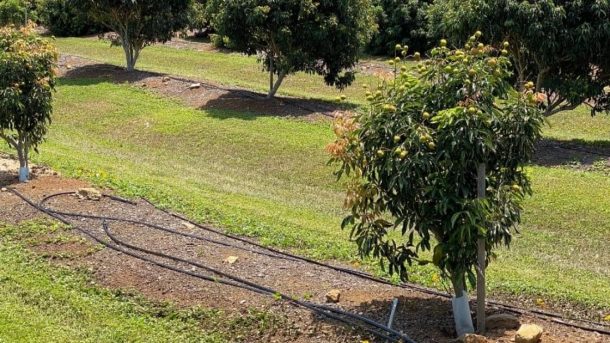
If you use micro irrigation to irrigate your litchi garden you will get tremendous result. In small litchi plants regular irrigation should be done at the time of establishment. For which irrigation should be done at an interval of 5-6 days in winter and 3-4 days in summer. Water should not be given 3-5 months before flowering (November to February) in full grown plants of Teevi which have started bearing fruit. The fruit development starts rapidly from six weeks before the fruit ripening (beginning of April) in the teacups.
Therefore, in the plants which have started fruiting, proper management and irrigation is required at this time. Lack of water leads to fruit development and cracking of fruits. Therefore, proper water management leads to proper development of the pulp and the problem of fruit cracking is reduced. Finally, I can say you that you will get 25-40% more yield as compare to previous year crop of without drip system. You can provide soluble fertilizer with venturi system so that plant root can accept fertilizer compare to any other methods.
What are the manures and fertilizers applied to litchi plant?
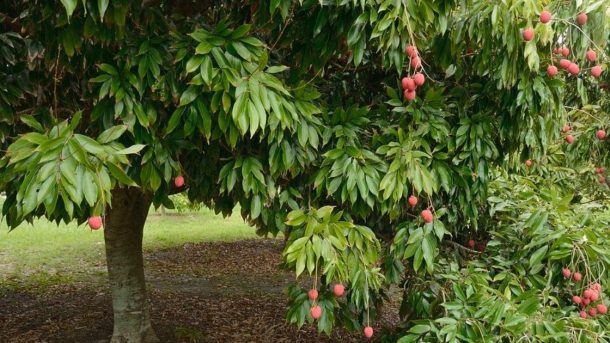
For the first 2-3 years 30 kg of Decomposed cow dung should be given to litchi plants, 2 kg karanj cake, 150 g urea, 150 g single super phosphate and 100 g. Muriate of potash should be given at the rate of one plant per year.
After that along with the growth of the plant the amount of manure should be increased. In this way 5 kg of decomposed cow dung 150 g Karanj, 150 g Urea, 200 g. CSF, 50 g muriate of potash per plant should be increased per year.
After about 15 years, 80-100 kg Dung manure in a fully grown tree. 3-4 kg Karanj cake, 2 kg Urea, 2.5 kg Sisufa and 0.6 kg. Muriate of potash should be given at the rate of one plant per year.
How propagation is done in litchi?
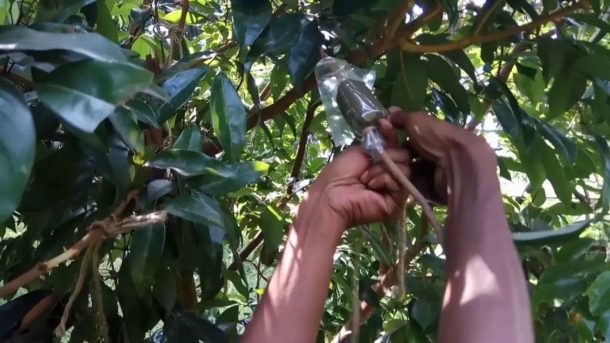
For commercial cultivation of litchi, only the plant prepared by Air layering should be used. Due to lack of parental qualities in seed plants good fruits do not come and fruiting is also delayed in them. To prepare this in the month of May-June choose a healthy and straight branch 40-50 cm from the top of the branch.
Make a 2 cm wide ring in the circle near a knot at the bottom. Applying a paste of 1000 ppm cover the honeycomb with moist moss and wrap a piece of white polythene of 400 gauge and tie it tightly with twine.
The roots are fully developed within about 2 months of tying the layering. Therefore, at this time about half the leaves of the branch were removed and cut from the main back and planted in a partially shady place in the nursery. There must be hardening required in the shed net for such type of plant.
What is China and it belongs to which cultivar?
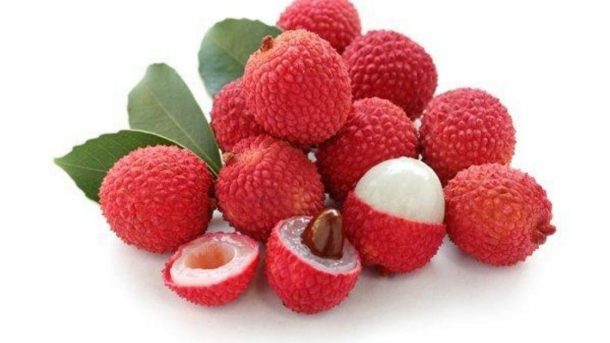
This is a late maturing straight variety of litchi with vines behind. The fruits of this film are large conical and free from the problem of cracking. It is in high demand due to its deep red color and high pulp content. But the problem of alternate function is seen in this film.
What is Shahi and it belongs to which cultivar?
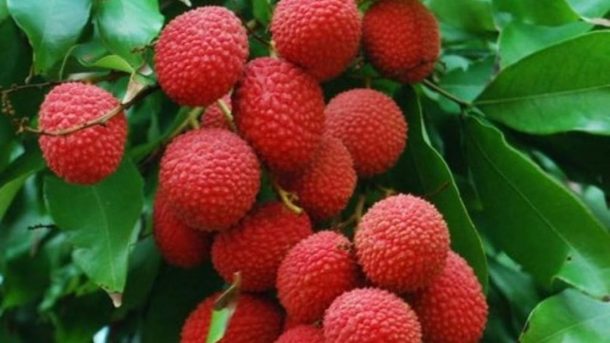
This is a commercial and early variety of the litchi which is becoming popular day by day. The fruits of this film are round and dark red in color, which ripen by 15-30 May. The fruit has a high amount of aromatic pulp, which is the main feature of this variety. Proper water management at the time of fruit development increases the yield. 80-100 or Upan can be obtained per year from 15–20-year-old plant of this variety.